CHAPTER THREE: THE SERPENT’S EYE
Three weeks into his ordeal, Arthur made his first true mistake.
He had grown complacent, he realized later. He had survived long enough to begin thinking of himself as competent, as someone who understood this island and its dangers. He had mapped a small territory around his beach—safe paths to his water source, safe places to gather fruit, safe spots to hide if the drums grew too close. He had learned to read the jungle’s signals, to notice when the birds fell silent or the insects stopped their chirping. He had begun to believe he might actually make it to the three-month mark.
The trap taught him otherwise.
It was a snare, but a cleverer one than any he had seen before. The trigger was hidden beneath a mat of leaves that looked identical to the surrounding ground. The rope was thin and dark, nearly invisible in the dappled light. The net was woven from vines, strong enough to hold a grown man, and when Arthur stepped into the trigger, the whole apparatus sprang into action with a speed that left him breathless.
One moment he was walking. The next, he was flying upward, the world spinning around him as the net closed tight around his body. He hit something—a branch, he thought—and then he was swinging, back and forth, suspended perhaps fifteen feet above the ground.
He hung there, stunned, trying to process what had happened. His knife was still in his belt, but his arms were pinned by the net. His legs dangled uselessly beneath him. He could not reach the rope that held him, could not cut himself free, could not do anything but swing and wait.
He did not wait long.
They emerged from the jungle in silence. Arthur had expected shouting, perhaps, or the beating of drums—some warning that his captors were approaching. But the Serpent-Kin made no sound at all. They simply appeared, one by one, stepping out from between the trees like ghosts given solid form.
There were six of them. Their bodies were painted in swirling patterns of white, red, and black, the designs flowing across their chests and arms and faces like living things. They wore skirts of woven grass and necklaces of shells and teeth. Their hair was dark and long, bound back with cords of fiber or left to hang free. And their eyes—their eyes were dark and flat and utterly without mercy.
One of them carried a spear. Two carried blowpipes, the darts already seated in the mouthpieces. The others had knives—stone blades lashed to wooden handles—and they held these blades with the casual ease of men who had used them many times before.
They stared at Arthur. Arthur stared back.
He tried to speak, to explain himself, to plead for mercy in a language they could not understand. The words came out as a croak, barely audible, and the Serpent-Kin did not react. They simply stood there, watching him swing, their expressions unreadable.
The one with the spear stepped forward. He was taller than the others, with broader shoulders and a headdress made from the skull of some large animal—a serpent, Arthur realized with a chill, the jawbones spread wide to frame the warrior’s face. He raised his spear and pointed it at Arthur’s chest, and he spoke.
The words were guttural, full of clicks and stops that Arthur’s English tongue could not replicate. But the meaning was clear enough. The warrior was asking a question, or perhaps issuing a command. Arthur shook his head, tried to explain that he did not understand, and the warrior’s eyes narrowed.
This was the end. Arthur knew it with a certainty that settled into his bones like cold water. He had survived three weeks on this island, had dodged traps and avoided patrols and built himself a life from nothing, and now it would end with a spear through his chest or a dart in his throat. He thought of England, of the green fields and gray skies he would never see again. He thought of his mother, who would wait for letters that would never come.
He thought of Davies, the cabin boy, and Higgins, the carpenter, and all the others who had died in the storm. He would join them soon.
And then the jungle erupted.
Arthur did not see the creature at first. He heard it—a snarl, deep and throaty, that seemed to come from everywhere at once. The Serpent-Kin turned, their spears and blowpipes raised, their painted faces shifting from cold calculation to something that might have been fear. The jungle around them rustled, leaves shaking, branches bending, and then the beast was there.
It was a cat, but unlike any cat Arthur had ever seen. Its body was the size of a small horse, covered in fur the color of rust and shadow. Its muscles moved beneath its skin like snakes, coiling and uncoiling with every step. Its eyes were yellow, slit-pupiled, and fixed on the Serpent-Kin with an intensity that made Arthur’s blood run cold.
The beast roared again, and the Serpent-Kin scattered.
It was not a rout—these were warriors, after all, and they fell back in good order, their weapons still raised, their eyes still watchful. But they fell back, giving ground to the creature, and in the chaos of their retreat, someone cut the rope that held Arthur’s net.
He fell. The ground rushed up to meet him, and he hit hard, the impact driving the breath from his lungs. The net had loosened in his fall, and he fought his way free, his fingers numb and clumsy, his mind screaming at him to move, to run, to do anything but lie here and die.
He ran. He did not know which direction, did not care, did not look back to see if the beast was following or the Serpent-Kin were pursuing. He crashed through the jungle, branches whipping at his face, thorns tearing at his skin, his lungs burning, his legs screaming. He ran until he could run no more, and then he found a cave—a small, dark opening in a hillside, barely large enough to admit his body—and he crawled inside.
The cave was damp and cold and smelled of old death. Arthur did not care. He curled into a ball in the darkness, his arms wrapped around his knees, and he shook. The sounds of the jungle were muffled here, distant, but he could still hear them—the snarl of the beast, the shouts of the warriors, the beating of drums that had begun somewhere in the distance.
He stayed in the cave until the sounds faded. He stayed until his shaking stopped. He stayed until he could think again, could remember who he was and why he was here and what he needed to do to survive.
When he finally crawled out, the sun was setting. The jungle was quiet, the drums had fallen silent, and Arthur was alone.
He looked at his hands. They were still shaking, just a little. He looked at the jungle, dark and watchful and full of teeth. He looked at the sky, where the first stars were beginning to appear.
“Three months,” he whispered. “You only have to survive three months.”
But even as he said it, he knew that three months was an eternity. And he knew, with a certainty that had nothing to reason and everything to instinct, that the island was not going to let him go.
The drums began again, soft and distant, and Arthur walked back toward his beach.
- Story
THE SERPENT’S NEW SON
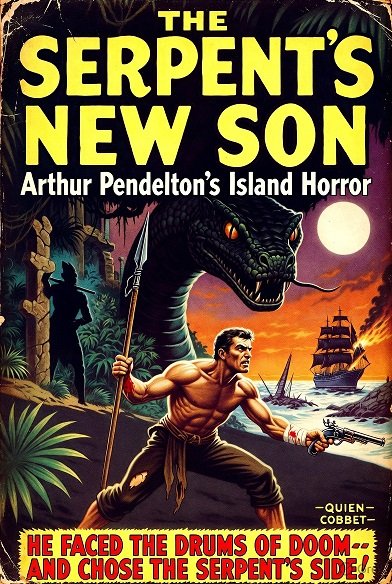 What if the island didn’t want to kill you—it wanted to claim you? A 1920s-style pulp horror novel of survival, magic, and transformation. Shipwreck. Serpent magic. Pirates. An English sailor’s survival becomes a dark destiny. 1920s pulp adventure.
0 Comments